Introduction
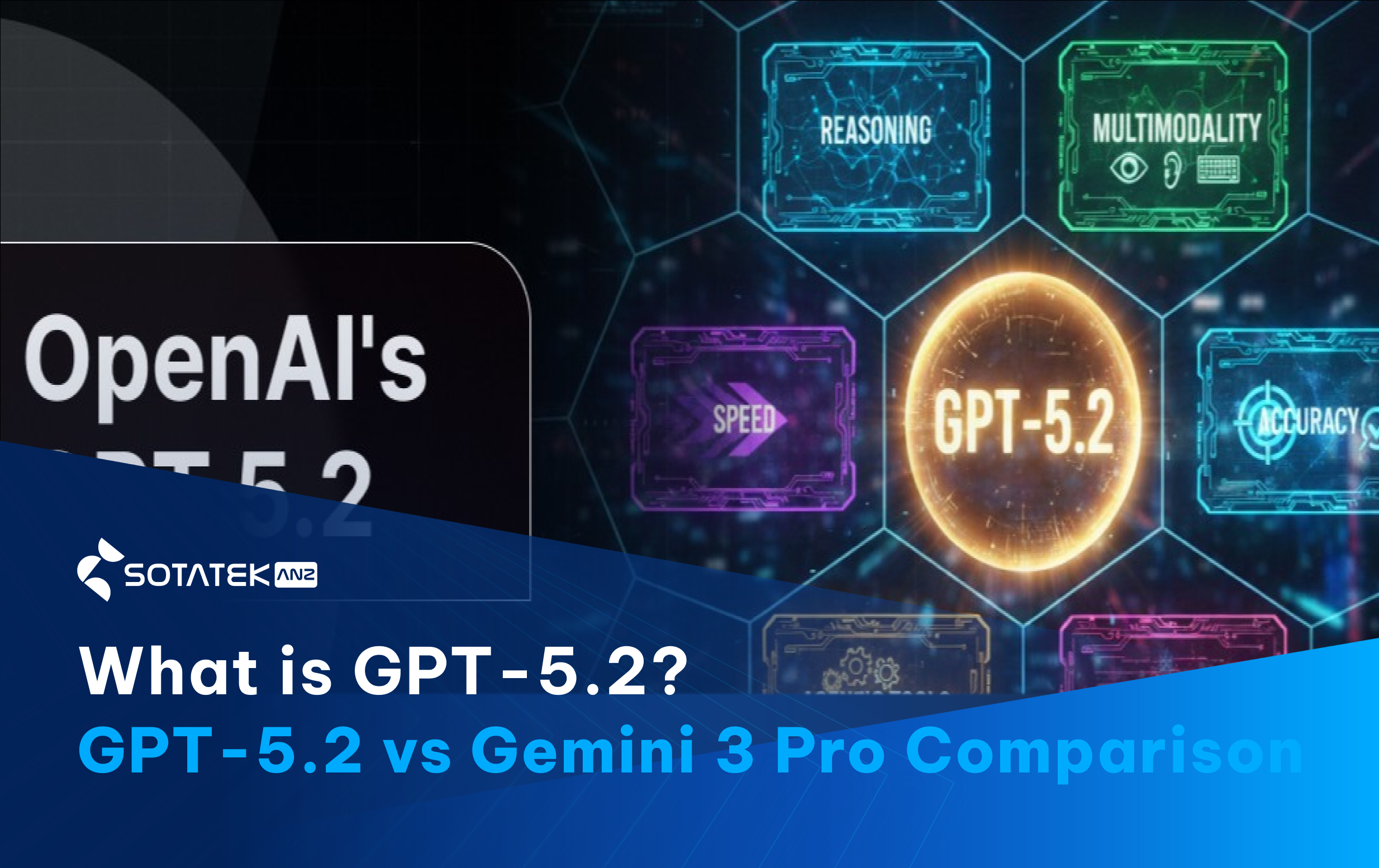
OpenAI has introduced GPT-5.2, its latest flagship model aimed at pushing practical AI performance further for real-world use. Positioned as a step beyond GPT-5.1, GPT-5.2 focuses on what matters most in production environments: stronger reasoning, more reliable multimodal understanding, higher-quality coding outputs, longer context handling for complex documents, and smoother workflow automation across multi-step tasks.
Rather than being “just a smarter chatbot,” GPT-5.2 can support specialized enterprise needs, from decision support and analytics to software development, knowledge management, and operational automation. The goal is clearer than ever: help teams move from impressive demos to dependable systems they can deploy at scale with confidence.
In this article, SotaTek ANZ will unpack what’s new in GPT-5.2, highlight the most relevant performance signals and benchmarks, and then compare it directly with Gemini 3 Pro so you can understand where each model excels, what trade-offs to expect, and which one fits different business and technical priorities.
What is GPT-5.2?
GPT-5.2 is framed as a next-generation model built for specialized business workflows, not just a conversational chatbot. According to internal testing, enterprise users can save roughly 40 to 60 minutes per day by offloading repetitive work to the model.
Its strengths show up most clearly in high-accuracy, multi-task scenarios, including:
- Creating and analyzing complex spreadsheets
- Building tailored, business-ready presentations
- Producing high-quality code
- Interpreting images and extracting meaning from long, context-heavy documents
Reliability is one of the hardest problems to solve when deploying LLMs at scale, and GPT-5.2 is positioned as a major improvement on that front. It reportedly scores 70.9% on the GDPval benchmark, up from 38.8% in the previous version, with results suggesting performance at or above human experts across 44 job categories.
What's new in GPT-5.2?
GPT-5.2 brings sharper, more focused upgrades in reasoning, memory, and tool use. OpenAI says these changes strengthen enterprise workflows and reduce failure points, and each model in the GPT-5.2 lineup delivers those gains in its own way.
GPT-5.2 Instant
GPT-5.2 Instant is built for speed and low latency. It it a reliable workhorse for everyday tasks like research, drafting, and translation. It’s commonly the default choice because it prioritizes high throughput over deep reasoning. In practice, it’s best when you need quick answers or lightweight automation, especially in cost-sensitive use cases where advanced inference isn’t necessary.
GPT-5.2 Thinking
Being optimized for stronger reasoning, GPT-5.2 Thinking works through complex problems more methodically before responding. OpenAI’s benchmarks highlight leading performance across knowledge work, coding, and long-context tasks, especially when paired with tools such as spreadsheets and presentation builders. It’s positioned as a general-purpose engine for analytical work, multi-step workflows, and agent-style tasks where careful thinking improves accuracy.
GPT-5.2 Pro
GPT-5.2 Pro is the top-tier option in the series, aimed at enterprise environments. It comes at the highest cost, but targets situations where extra gains in reasoning depth, factual precision, and abstract problem-solving justify the price. Pro is designed for high-stakes work that demands consistency over very long contexts—well suited for decision support, complex planning, and reliability-critical workflows.
GPT-5.2 benchmark
Coding
SWE-Bench Pro and SWE-Bench Verified are benchmarks that evaluate the ability to solve real software problems on GitHub repositories. Unlike the Verified version, which only supports Python, SWE-Bench Pro covers four programming languages and is a more difficult evaluation intended for industrial use.

SWE-Bench Pro (Source: OpenAI)
GPT-5.2 Thinking achieved a new best score (SOTA) of 55.6% on SWE-Bench Pro, while achieving 80.0% on the more established SWE-Bench Verified.
This result is roughly on par with Claude Opus 4.5 (80.9%) and outperforms Gemini 3 Pro (76.2%). It is a clear improvement over GPT-5.1 (76.3%) and demonstrates its position as a highly suitable addition to professional development workflows for complex, cross-language bug fixing.
Inference
Inference benchmarks evaluate a model's ability to solve complex, uncharted problems. GPQA Diamond measures PhD-level scientific knowledge, while ARC-AGI-1 and ARC-AGI-2 focus on solving abstract visual puzzles that cannot be solved by memorization. These benchmarks are crucial for building agents that can think and execute multi-step instructions.
GPT-5.2 Thinking achieved 92.4% on GPQA Diamond, a 4.3-point improvement over GPT-5.1. This slightly beats Gemini 3 Pro (91.9%) and shows a significant advantage over Claude Opus 4.5 (87%) on advanced scientific questions. The most notable improvement is its improved ability to reason abstractly.

GPT-5.2 Thinking vs GPT-5.1 Thinking
Of particular note is its score of 52.9% on ARC-AGI-2, which significantly outperforms Claude Opus 4.5 (37.6%) and nearly doubles the performance of Gemini 3 Pro (31.1%), demonstrating a fundamental enhancement in non-verbal problem-solving abilities.
Mathematics
The AIME 2025 benchmark is based on challenging mathematical competitions and assesses quantitative reasoning ability, while the new FrontierMath benchmark measures the ability to address open problems at the forefront of advanced mathematics, providing a more direct indication of a model's performance.
ChatGPT 5.2 Thinking achieved a perfect score of 100% on AIME 2025 without any tools, reaching the same level as Claude Opus 4.5, while the Gemini 3 Pro performed about 5% lower than the other models.
The biggest differentiator is its performance on FrontierMath. ChatGPT-5.2 Thinking achieved 40.3% on Tiers 1-3, an improvement of approximately 10 points over GPT-5.1. This high base performance indicates that the model's innate mathematical intuition is stronger, meaning it is less reliant on external tools to find solutions.

FrontierMath (Tier 1-3)
Task Accomplishment
The ability to go beyond single interactions and plan and execute multi-step workflows is a key measure of a model's Agentic Capabilities, which GDPval assesses across well-defined knowledge work tasks across 44 professions.
ChatGPT-5.2 performed as well as or better than leading industry experts in 70.9% of comparisons. This benchmark requires the creation of real-world work artifacts such as presentations and spreadsheets, making it a powerful indicator of realistic, practical support.
These results demonstrate that ChatGPT-5.2 can consistently execute complex tasks from start to finish, maintaining consistency and quality over time.
Long-text context processing
The value of a large context window is determined by its ability to accurately search and recall information. The MRCRv2 benchmark evaluates the ability to find specific information in a large amount of text, the so-called "needle-in-a-haystack" approach.

OpenAI MRCRv2
GPT-5.2 Thinking demonstrated near-perfect recall performance, scoring 98% on the 4-needle test and 70% on the 8-needle test, within the full context of up to 256K tokens.
Furthermore, in an 8-needle test with 128K token input, it achieved an average match rate of 85%, significantly higher than the 77% achieved by Gemini 3 Pro. This result demonstrates that GPT-5.2's context window is not only large, but also extremely reliable, enabling it to effectively utilize information buried in vast documents in practice.
Visual Comprehension
Native multimodal models are evaluated on their ability to understand and reason across different data formats. MMMU-Pro, Video-MMMU, and CharXiv are leading benchmarks for joint understanding of images, videos, and scientific diagrams.
On MMMU-Pro, ChatGPT 5.2 achieved 86.5% (90.1% using Python), a slight improvement over the previous generation GPT-5.1 (85.4%) and continuing to outperform Gemini 3 Pro (81%).
In Video-MMMU, GPT-5.2 achieved a score of 90.5%, outperforming Gemini 3 Pro (87.6%), demonstrating that GPT-5.2's strengths extend beyond still images, demonstrating its advanced ability to understand dynamic video content.
Additionally, on the CharXiv (Python) benchmark, GPT-5.2 achieved an extremely high score of 88.7%, significantly outperforming Gemini 3 Pro (81.4%), confirming its superiority in interpreting complex data visualizations and scientific charts.

CharXiv (Python) benchmark
Tool Call
The ability to consistently use external tools is essential to building powerful AI agents, and Tau2-bench Telecom is a benchmark that assesses this ability through realistic and complex tool usage scenarios in the telecommunications industry.

Tau2-bench Telecom
GPT-5.2 Thinking achieved 94.5% on this benchmark, a significant improvement over the Gemini 3 Pro (85.4%), but just behind Claude Opus 4.5 (98.2%).
Comparison of GPT-5.2 and Gemini 3 Pro
Model Overview
GPT-5.2: Three models optimized for different uses
GPT-5.2 is available to paid ChatGPT users and via API in three variations:
- GPT-5.2 Instant: A model optimized for speed, suitable for everyday tasks such as answering questions, information search, writing sentences, summarizing, and translation.
- GPT-5.2 Thinking: A model designed for tasks that require deep thinking. It excels at coding, long document analysis, mathematical reasoning, planning, and multi-step tasks. It is OpenAI's most advanced reasoning model for professional workflows.
- GPT-5.2 Pro: Our flagship model delivers the highest level of quality and accuracy, designed for challenging questions, complex coding, scientific reasoning, and mission-critical tasks.
GPT-5.2 has made significant advances in long-text context processing, structured reasoning, tool utilization, factuality, coding accuracy, and visual understanding in technical scenarios.
ChatGPT alone does not support native video generation, but it can be used in conjunction with Sora where available.
Gemini 3 Pro: Google's Complete Multimodal Engine
Gemini 3 Pro is Google's most advanced model to date, designed as a fully multimodal system that natively handles text, images, audio, and video, powering Google AI Mode, the Gemini app, NotebookLM, various Android features, and integrating across Google services like Gmail, Docs, and Search.
In independent user rating leaderboards like LMArena, the Gemini 3 series currently ranks #1 in text, vision, text-to-image generation, image editing, and multimodal search , and when combined with Google Veo 3, it also demonstrates top-tier performance across the ecosystem in text-to-video and image-to-video .
The Gemini 3 Pro is designed for creativity and everyday interaction , rather than just reasoning capabilities .
GPT-5.2 vs Gemini 3 comparison chart
|
Category |
GPT-5.2 |
Gemini 3 Pro |
|
Model Overview |
Emphasis on inference. 3 models (Instant / Thinking / Pro) optimized for each purpose |
Native fully multimodal (text, images, audio, video) |
|
Text Inference |
Best-in-class structured and incremental reasoning |
Powerful but somewhat weak in structured reasoning |
|
Coding |
Highest class in SWE-Bench Verified. Strong in agent-based development. |
Very powerful, but close behind in advanced structured reasoning |
|
Long-form context |
High-precision recall and inference with 256K tokens |
Good, but not the best for super long sentences |
|
Job aptitude |
Ideal for spreadsheets, documentation, analysis, and planning |
Wide range of uses, but not optimized for deep business structuring |
|
Factuality and reliability |
Improved accuracy and reduced hallucination |
Powerful but variable in multimodal conditions |
|
SOTA performance |
ARC-AGI-2, AIME, GPQA Diamond, Long-Text Reasoning |
Image generation, visual understanding, multimodal search, video generation (collaboration) |
|
Image Understanding |
Strong in diagrams, charts, and technical screenshots |
Very strong spatial and visual understanding |
|
Image generation |
Limited (not the main focus) |
Industry leader in text to image and image editing |
|
Audio |
Moderate |
Real-time audio processing is very powerful |
|
Video Generation |
Not supported by ChatGPT alone (only when linked to Sora) |
Veo 3 integration is strong in text → video / image → video |
|
Multimodal Capabilities |
Analysis and inference-based multimodal understanding |
Highly creative and real-time |
|
Ecosystem |
ChatGPT, API, and enterprise tool integration |
Deep integration with Google Workspace, Android, Search, and AI Mode |
|
Speed and operability |
Instant is for fast speed, Thinking/Pro is for deep thinking |
Fast and fluid multimodal interaction |
|
Intended users |
Developers, analysts, researchers, and enterprise users |
Creators, designers, students, general users |
|
Price Trends |
Cost-effective for input-intensive tasks |
Advantageous for visual and media applications with high output volume |
Pricing Plans
Model names in ChatGPT and API
|
ChatGPT |
API |
|
ChatGPT-5.2 Instant |
gpt-5.2-chat-latest |
|
ChatGPT-5.2 Thinking |
gpt-5.2 |
|
ChatGPT-5.2 Pro |
gpt-5.2-pro |
The API pricing for GPT-5.2 is as follows:
- Input : $1.75 / 1 million tokens
- Output : $14 / 1 million tokens
- Cached Input : 90% discount ($0.175 / 1 million tokens)
Evaluations of multiple agent-based models have confirmed that although GPT 5.2 has a higher token cost, its high token efficiency results in a lower overall cost to achieve comparable quality. There are no changes to the ChatGPT subscription fee. Meanwhile, for APIs, GPT 5.2 is priced higher than GPT-5.1 due to significantly improved model performance. Nevertheless, it remains competitively priced compared to other cutting-edge models, and is expected to be used continuously in daily operations and mission-critical applications.
Token unit price list (per 1 million tokens)
|
Model |
Input |
Cache Input |
output |
|
gpt-5.2 / gpt-5.2-chat-latest |
$1.75 |
$0.175 |
$14 |
|
gpt-5.2-pro |
$21 |
― |
$168 |
|
gpt-5.1 / gpt-5.1-chat-latest |
$1.25 |
$0.125 |
$10 |
|
gpt-5-pro |
$15 |
― |
$120 |
Conclusion
To conclude, Gemini 3 Pro shines in multimodality and Google ecosystem integration, while GPT-5.2 focuses on structured reasoning, business artifacts, and planning for real work.
If you’re exploring which model fits your roadmap and how to deploy it safely at scale, contact SotaTek ANZ to discuss an AI strategy tailored to your business.